
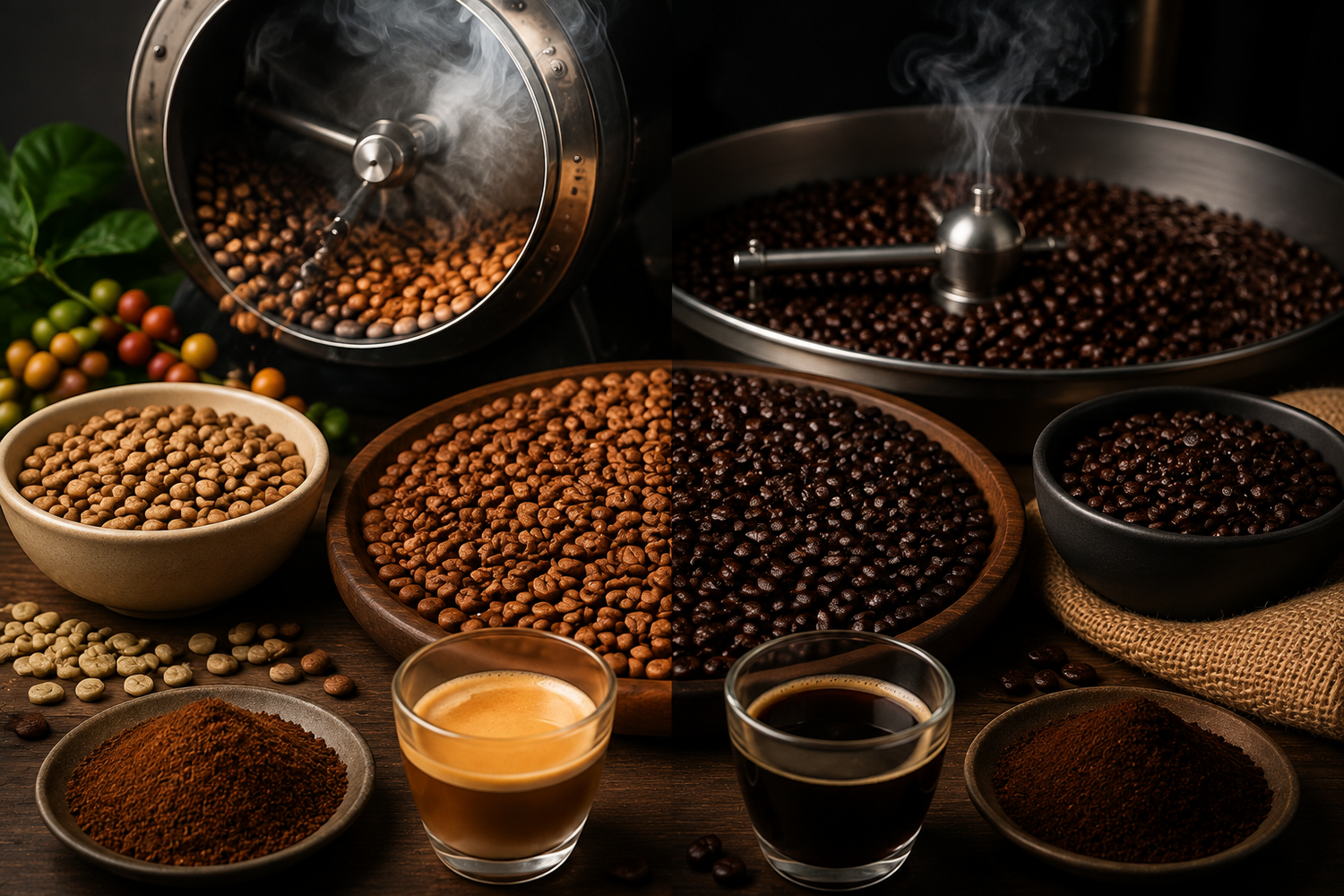
Walk into any specialty coffee shop and you'll face the same question: light or dark roast? It sounds simple, but the answer touches on chemistry, biology, and personal taste in ways most coffee drinkers never fully explore. Understanding roast profiles — and the critical role of degassing — will transform how you select, store, and brew coffee with your KaffaGo machine.
What Roasting Actually Does to Coffee
Green coffee beans are dense, grassy-smelling seeds with very little of the flavor we associate with coffee. Roasting applies heat (typically 180–230°C) over 8–15 minutes, triggering hundreds of chemical reactions that develop flavor, aroma, color, and body. The two most important processes are:
- Maillard Reaction: Amino acids and sugars react under heat to create complex browning compounds — the source of roasty, nutty, caramel, and chocolate flavors
- Caramelization: Sugars break down and transform into caramel compounds, adding sweetness and body
The longer and hotter the roast, the more these reactions progress — and the more the bean's original character is transformed or lost.
Light Roast: Origin Forward, Complexity First
Light roasts are taken to an internal bean temperature of roughly 180–205°C, stopping before or just at the "first crack" — the audible pop that signals the bean's cell structure is expanding.
Flavor profile:
- Acidity: High and bright — citrus, berry, stone fruit, floral notes
- Sweetness: Delicate, fruit-forward
- Body: Light, tea-like, clean
- Bitterness: Very low
- Origin character: Fully preserved — you taste the terroir, the variety, the processing method
Best for:
Ethiopian single origins like Yirgacheffe and Kaffa naturals shine brightest as light roasts. Their jasmine, blueberry, and bergamot notes are heat-sensitive — darker roasting destroys them. Light roasts also tend to have slightly higher caffeine content by weight, as caffeine degrades slightly with extended roasting.
Espresso considerations:
Light roasts are more challenging to extract as espresso. Their higher density and lower solubility require a finer grind, higher water temperature (92–94°C), and careful pressure management. The KaffaGo Nomad Pro V2's consistent 19-bar output makes it one of the best portable tools for light roast espresso — many lower-pressure devices simply can't extract them properly.
Dark Roast: Bold, Consistent, Forgiving
Dark roasts reach internal temperatures of 225–230°C, well past the "second crack." The bean's surface becomes oily as internal oils migrate outward. Much of the original origin character is replaced by roast-derived flavors.
Flavor profile:
- Acidity: Low — most bright acids have been broken down by heat
- Sweetness: Deep, bittersweet, dark chocolate, molasses
- Body: Full, heavy, coating
- Bitterness: Pronounced — from degraded chlorogenic acids and other roast compounds
- Origin character: Largely masked by roast flavors
Best for:
Dark roasts excel in milk-based drinks — lattes, cappuccinos, flat whites — where their bold flavor cuts through dairy. They're also more forgiving of extraction variables: grind inconsistencies, temperature fluctuations, and tamping pressure have less impact on the final cup than with light roasts.
Espresso considerations:
Dark roasts extract easily and quickly. Use a slightly coarser grind and lower water temperature (88–90°C) to avoid over-extraction and excessive bitterness. The oily surface of dark roast beans can clog grinder burrs faster — clean your grinder more frequently if you brew dark roasts regularly.
The Degassing Factor: Why Fresh Isn't Always Best
Here's the part most coffee drinkers don't know: freshly roasted coffee is not ready to brew.
During roasting, beans absorb large amounts of CO₂ gas. After roasting, this gas slowly releases — a process called degassing or off-gassing. If you brew coffee too soon after roasting, excess CO₂ interferes with extraction, creating uneven, sour, and gassy-tasting espresso. The CO₂ also causes the bloom in pour over to be overly vigorous, pushing water away from the grounds.
Degassing timelines by roast level:
- Light roast: Rest 7–14 days after roast date before brewing as espresso. The denser cell structure releases CO₂ more slowly.
- Medium roast: Rest 5–10 days. A good middle ground for most brewing methods.
- Dark roast: Rest 3–5 days. The more open cell structure releases CO₂ rapidly — dark roasts degas faster but also go stale faster.
The freshness window:
After degassing, coffee enters its peak flavor window — typically 2–4 weeks past roast date for espresso. After that, oxidation begins to flatten flavors. This is why KaffaGo capsules use nitrogen-flush sealing: by replacing oxygen with inert nitrogen, we lock in peak-window freshness indefinitely until you're ready to brew.
Choosing Your Roast for the KaffaGo Experience
- For origin exploration and single-origin appreciation: Light roast, rested 10–14 days
- For everyday espresso with balanced flavor: Medium roast, rested 7–10 days
- For bold shots, milk drinks, or forgiving backcountry brewing: Dark roast, rested 3–5 days
- For maximum convenience and guaranteed freshness on expeditions: KaffaGo nitrogen-sealed capsules — no resting required
The best roast is the one that matches your moment. Light roast at a slow Sunday morning. Dark roast at a pre-dawn summit push. The KaffaGo machine handles both beautifully — you just need to know what you're working with.
Explore our curated range of light, medium, and dark roast coffees — all sourced from Ethiopia's finest growing regions and roasted to highlight their unique character.


Leave a comment
This site is protected by hCaptcha and the hCaptcha Privacy Policy and Terms of Service apply.